Agentic Websites
Why Websites Changed
From digital brochure to responsive website, to lead-generation site, to Agentic Website. Learn why websites changed and what customers now expect.
In this article
The website has changed more in the last five years than in the twenty before. What was once a digital brochure — a page that displayed information — has become a system that responds, remembers and works. This is the story of how and why that change happened.
Stage 1: the digital brochure
The first business website was an online brochure. It displayed information: who we are, what we do, where we are, how to contact us. The visitor read and, if they wanted to do anything, had to use another channel: call, visit, email. The site did nothing by itself. It was a storefront.
This model worked while customers used the internet primarily to research. But as expectations changed, the digital brochure fell short. Customers no longer just wanted to read; they wanted to act.
Stage 2: the responsive website
With the arrival of the smartphone, the website had to adapt. It was no longer enough to look good on a desktop screen; it had to work on mobile, tablets and any device. Responsive design was born: a site that adjusts to screen size.
The responsive site solved a technical problem but did not change the function. It was still a brochure — more accessible, more readable, but equally passive. The visitor still had to find another channel to act.
Stage 3: the lead-generation site
The next change was lead capture. The site began to include forms, call-to-action buttons and landing pages designed to convert visitors into contacts. The site no longer just displayed; it asked for data.
But the lead-generation site had a limit: it captured the contact but did not act on it. The form arrived in an inbox, and from there everything depended on the human team. If the team responded quickly, the lead advanced. If they delayed, it was lost. The site was the start of the process but did not participate in the rest.
Stage 4: the Agentic Website
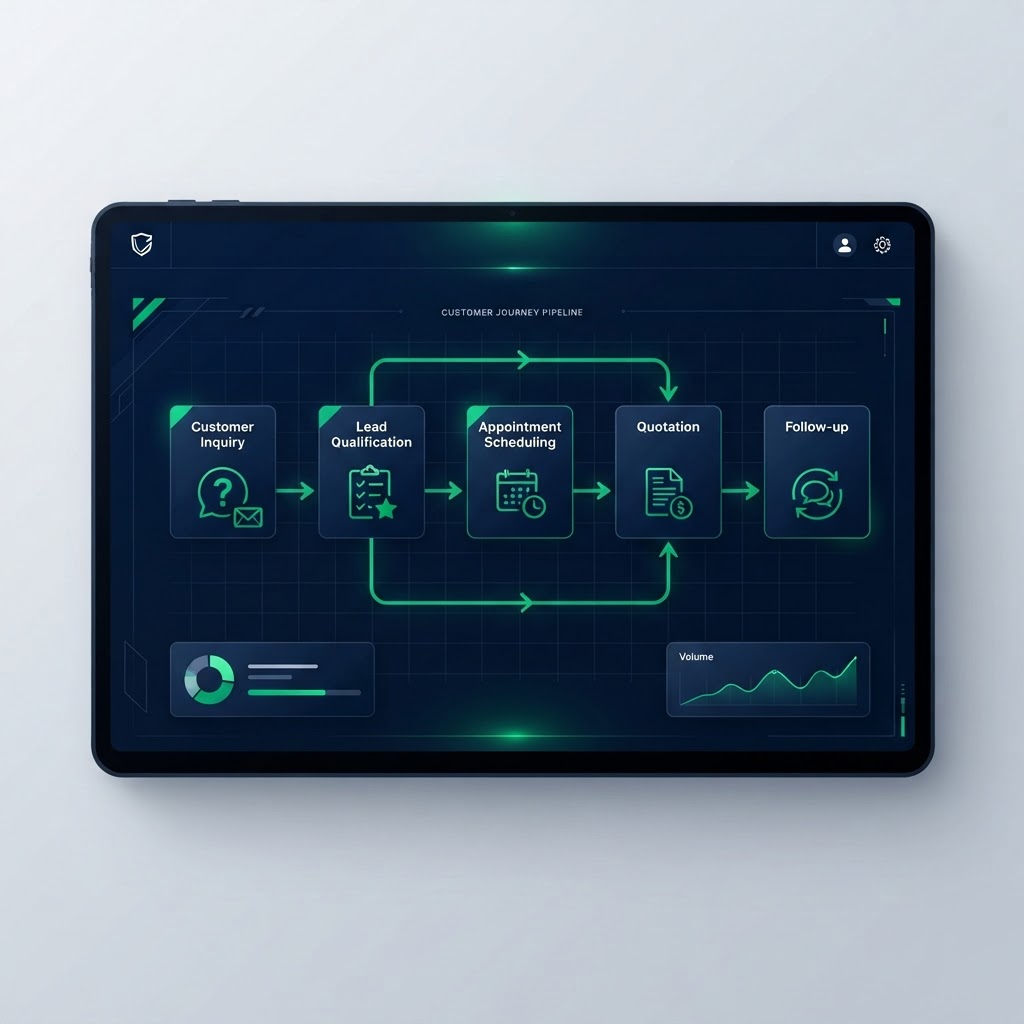
The Agentic Website is the next evolution. It does not just display information or capture leads. It actively participates in the commercial process: responds to customers immediately, remembers conversations, qualifies opportunities, prepares quotations, books appointments and follows up — all within processes defined by the company.
The difference is not one of degree; it is one of category. The brochure displays. The responsive site adapts. The lead-generation site captures. The Agentic Website works.
Why it changed: customer expectations
Customers changed. They are no longer willing to wait. When a customer arrives with a question at 10 PM, they expect a response. Not tomorrow. Not when someone checks email. Now. If the site does not respond, the customer seeks a competitor who does.
WhatsApp accelerated this expectation. In Mexico, customers use WhatsApp for everything: asking, quoting, booking, complaining. They expect immediate responses on their preferred channel. A site that does not connect to WhatsApp is disconnected from the customer.
Why it changed: connected systems
The systems the business uses — CRM, calendar, email, WhatsApp — used to be isolated. Now they can connect. An Agentic Website leverages that connection to execute complete processes: record the interaction in the CRM, send the WhatsApp confirmation, book in the calendar, all without manual intervention.
Why it changed: AI and answer engines
Artificial intelligence matured. It is no longer a curiosity; it is a tool capable of understanding questions, searching a knowledge base and building accurate responses. At the same time, AI engines — Google AI Overviews, ChatGPT, Perplexity — changed how customers search. They no longer just see links; they see answers. This requires websites to be clear, structured and semantically coherent.
Why it changed: speed
Response speed became a conversion factor. Studies are consistent: the probability of converting a lead drops dramatically after the first few minutes. A site that does not respond immediately loses opportunities, no matter how well designed it is.
What did not change
What did not change is the importance of human judgment. Automation does not replace the team; it frees them from repetitive tasks so they can focus on what people do best: build relationships, make judgment decisions and grow the business. The Agentic Website works within rules; sensitive decisions remain human.
Conclusion
Websites changed because customers, systems and technology changed. The digital brochure was sufficient when displaying was sufficient. Today it is not. The website must participate in the commercial process, not just observe it. That is the difference between a traditional site and an Agentic Website.
Frequently asked questions
Is my current site already obsolete?
Not necessarily. A responsive site with good information is still valuable. The question is whether the site only displays, or whether it also responds, remembers and works. If it only displays, there is an opportunity.
Do I need to redesign my site from scratch?
It depends. In some cases the agentic system is integrated behind the existing site. In others, it is more efficient to redesign. It is evaluated case by case.
AUTHOR
Adam Behr
Founder and Managing Director, AJ Partners
Adam Behr is the founder and managing director of AJ Partners. He designs proprietary business systems with Agentic Websites and AI Employees for growing companies in Mexico.
View LinkedIn profileAJ PARTNERS SERVICES